 Fourth Edition.jpg)



My Cart

In stock
£480.00
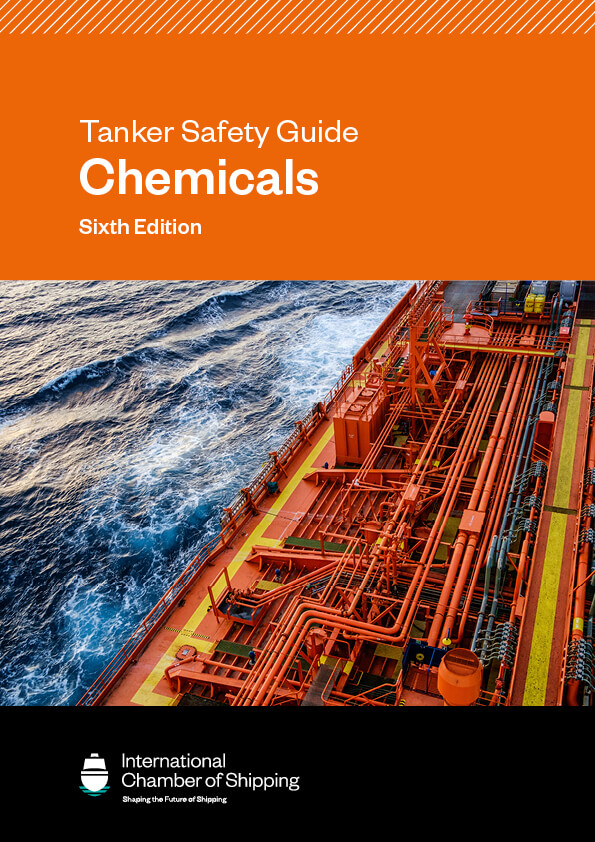
The ICS Tanker Safety Guide (Chemicals) is the trusted publication for chemical tankers since 1971. Now in its sixth edition, the guide continues to translate the regulatory requirements of MARPOL Annex II into practical on board procedures for safe and environmentally responsible operations.
Readers can expect updated and expanded guidance on:
It is recommended that this guide and its companion, International Safety Guide for Oil Tankers and Terminals (ISGOTT), are on board all ships carrying hazardous and noxious chemicals in bulk. The Tanker Safety Guide (Chemicals) Sixth Edition is essential for anyone involved in the carriage of chemicals on ships, including crew on board chemical tankers, ship operators and managers, cargo interests and charterers, training institutes and terminal operators.
| Author | International Chamber of Shipping |
| Publisher | International Chamber of Shipping Publications |
| Edition | Sixth Edition |
| Publication month | 2026 - April |
| ISBN | 978-1-913997-76-2 |
| Shipping Weight | 1.700Kg |
The first edition of the ICS Tanker Safety Guide (Chemicals) was published in 1971. Revisions to subsequent editions of the guide have established it as the standard reference work for chemical tankers, taking particular account of the need for chemical tankers to comply with IMO regulations. This sixth edition continues to provide those serving on ships carrying hazardous and noxious chemicals in bulk with up-to-date information on recognised best practice for safe and pollution-free operations on ships regulated under MARPOL Annex II (Regulations for the Prevention of Pollution by Noxious Liquid Substances). New guidance aims to clarify Annex I to Annex II cargo changeovers, to ensure masters and shipowners are confident at every step during these tank cleaning operations. This sixth edition also details new content on the safe use of shore power and hot work hazardous zones. Reflecting that serious enclosed space accidents unfortunately continue to occur, primarily due to a failure to follow established procedures, the previous two editions of this guide provided updated and improved guidance on this essential safety topic. Following the updated enclosed space entry guidelines issued by the IMO, this sixth edition was further updated to help masters and crew understand the key safety requirements. As the industry moves toward limiting enclosed space entries wherever possible, ICS is pleased to include new guidance on washing water analysis that reduces the need for enclosed space entry and helps crew avoid unnecessary risk. The guide deals primarily with operational matters and best safety practices. It does not make recommendations on the construction or maintenance of chemical carriers or their equipment: such standards are set by IMO, national administrations and classification societies. Likewise, the guide does not address the operation of specific items of equipment or their repair. However, in some cases general reference is made to these matters as well as to relevant regulations. It is recommended that a copy of this guide be used on board all chemical tankers, which should also have on board the International Safety Guide for Oil Tankers and Terminals (ISGOTT) with which this guide is compatible and which should also be consulted, especially whenever oil cargoes are carried. This compatibility will provide consistent safe guidance and minimise the increasing burden associated with audits and vetting inspections. This guide is also a companion to the ICS Tanker Safety Guide (Liquefied Gas). |
Hazards and properties of chemicals 1.1 Introduction This chapter introduces the range of hazards normally associated with the properties of chemicals that are carried as cargoes, and the precautions necessary to minimise or avoid these hazards. Chemical tankers are designed and equipped to transport a wide range of different cargoes and often carry a large number of products simultaneously. The operation of chemical carriers differs from that of oil tankers in that on a single voyage a large number of cargoes with different properties and inherent hazards may be carried. In port, several products may be handled simultaneously at one berth, typically involving such different operations as loading, discharging and tank cleaning. The transportation of bulk chemicals by sea not only requires purpose-built ships and equipment, but also seafarers who have received specialist training, both theoretical and practical, in order to understand the properties of the various chemicals and the potential hazards involved in cargo operations. When planning the carriage of chemical cargoes, it is essential that the ship’s crew and the managing company are provided with a full specification of each cargo in order to ensure compliance with international stowage, handling and carriage requirements. Furthermore, the cargo details should provide the ship’s crew with all of the information that they may require in order to handle the cargo safely and to minimise the impact that cargo operations may have on the environment. 1.2 Physical properties 1.2.1 Specific gravity and density Because specific gravity (SG) is expressed as a ratio, it has no measurement units. However, the specific gravity can vary according to the temperature of the product. It is quite common to see the specific gravity quoted as 20°C/4°C, which refers to the density of the product at a temperature of 20°C referenced against the density of water at a temperature of 4°C. This temperature reference is selected because water has its maximum density of tonnes/m3 at 4°C. For chemical carriers, design parameters specify the maximum density of products that can be carried in each cargo tank. The design strength can differ between various tanks on board the same ship, resulting in different maximum densities and maximum filling ratios (see section 5.2: Cargo tanks). The information regarding tank strengthening can be found in the classification society’s specifications for the ship, and the master should be familiar with any restrictions that may be imposed when loading high density cargoes. Especially important is the need to be aware of and where possible avoid or manage the risk of slack loading a tank. This is because slack loading can lead to sloshing forces that may cause damage to the tank structure or its internal fittings and equipment. Classification societies provide information about tank strength in various formats and the master should ensure that the restrictions are understood and that there is full compliance. 1.2.2 Volume expansion coefficient Whereas the mass of a product does not vary with temperature its volume generally expands with increasing temperature. As a consequence, the density will vary with temperature. For chemicals, density at standard temperature (usually 20°C) is converted to density at the actual temperature, using the following formula: Da = Dr + ((Tr – Ta) × DCF) Where: Da = density at actual temperature (Ta) Dr = density at reference temperature (Tr) DCF = density correction factor/°C Density correction factors are usually not stated in the safety data sheet (SDS) or commodity databases and will typically be obtained from the loading master or cargo surveyor. Sufficient space must be allowed in the tank for the expected expansion of the cargo during the voyage due to a rise in outside temperatures or of a cargo being similarly affected by heated cargoes in adjacent tanks. 1.2.3 Melting/freezing point For most pure chemicals the melting and freezing points are approximately equal. However, some products such as vegetable oils, creosote oil, lube oil additives and clean petroleum products, whose quality varies in non-insulated pipes and vents may solidify. Should vent lines or vents be blocked, structural damage may occur due to a vacuum or overpressure developing within the tank. Cargoes with a melting point above the ambient temperature of the ship’s trading area will need to be heated in order to remain liquid. The structure and equipment of a ship can impose a limitation on the carriage of heated cargoes, which should be documented on board. Excessive heat can create thermal stresses within the steelwork of the tank and risk structural damage. Excessive heat can also damage the cargo tank coating or coatings in adjacent spaces such as ballast tanks. Coating manufacturers’ guidelines on temperature limits should be followed. Caution should be exercised when carrying products with a melting point above the ambient temperature as it may impact the quality of cargo in adjacent spaces, especially in the case of polymerising cargoes. Cargo in non-insulated pipes and vents may solidify. Should vent lines or vents be blocked, structural damage may occur due to a vacuum or overpressure developing within the tank. Cargo may solidify on the sensors used for measuring pressure, temperature and tank level gauging leading to inaccurate readings. 1.2.4 Vapour pressure The pressure of a liquid is defined as the pressure exerted by its vapour when the liquid and vapour phase are in thermodynamic equilibrium. In a closed system at constant temperature, liquid molecules are evaporating and vapour molecules are condensing, while the pressure remains constant. Vapour pressure increases with temperature, so when stating a vapour pressure it is also important to state the temperature. Vapour pressure is expressed in kPa (100kPa = 1bar = 14.5psi = 0.99atm). A product with a high vapour pressure at ambient temperatures is referred to as volatile. 1.2.5 Boiling point Boiling point is defined as the temperature at which the vapour pressure of a liquid equals the external pressure that is surrounding the liquid. The lower the external pressure, the lower the temperature at which the product will boil. In a closed cargo tank, a liquid will boil when the vapour pressure is equal to the external pressure plus the pressure setting of the pressure/vacuum (P/V) valve. The International Code for the Construction and Equipment of Ships Carrying Dangerous Chemicals in Bulk (IBC Code) requires that cargoes with a vapour pressure above 101.3kPa at 37.8°C (in other words a boiling point below 37.8°C) can only be loaded in tanks that have a mechanical cooling system or that are able to withstand the vapour pressure of the cargo at 45°C. 1.2.6 Vapour density Vapour density is the ratio of the mass of a given volume of vapour relative to the mass of the same given volume of air. Air has a vapour density of 1, which makes it very straightforward to see if a particular vapour is heavier or lighter than air. Most chemical cargoes have a vapour density of more than 1, which means that their vapours are heavier than air. Particular care must therefore be taken because vapour concentrations are likely to accumulate in semi-enclosed areas at deck level and at the bottom of enclosed spaces. At constant pressure and temperature, vapour density is proportional to the molecular mass of the product. |