Mapping a Maritime Just Transition for Seafarers
The world’s nearly 2 million seafarers are key to powering this industry through a successful transition to net zero. Seafarers will need adequate skills, education, and training, to operate new technology systems on board and to manage new fuels, such as ammonia and hydrogen, which unless properly handled could represent a significant health and safety risk for seafarers, ships, the environment and communities.
DNV Report
With future alternative fuel technologies, such as renewable e-fuels, biofuels and fossil fuels with carbon capture and storage, expected to introduce new training requirements for seafarers, the Task Force Secretariat (ICS, ITF and UN Global Compact) commissioned a major report from classification Society ‘DNV’, to explore how best to support seafarers during the transition and to provide an overview of the challenges that training seafarers throughout the transition will entail.
The report, which provides “Insights into seafarer training and skills needed to support a decarbonized shipping industry”, models three emission reduction scenarios to estimate the number of seafarers requiring additional training to handle alternative fuels up to 2050. All three scenarios highlight an immediate need to start putting the seafarer training infrastructure in place.
The report concluded that a lack of clarity about viability and uptake of alternative fuel options, as well as uncertainty surrounding regulatory developments and financing, is making it difficult to plan effectively for the transition of the maritime workforce and to attract investment towards new skills programmes, compatible with the industry’s needs for a decarbonised future.
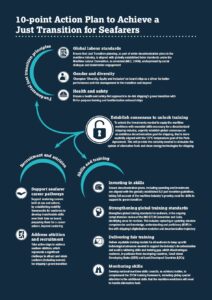
10-point-action plan
Informed by the findings of the DNV report, the Maritime Just Transition Task Force Secretariat (in consultation with other Task Force Members, IMO and ILO) developed a forward looking 10-point-action plan for international organizations, industry, workers and academia (including training providers), setting out concrete recommendations to unlock the seafarer skills needed to support shipping’s decarbonisation goals.
Related content

Why shipping’s next 39,100 officers are already onboard

CCC 12-3-8 – Comments on document CCC 12/3

Charting the Course: Global Shipping Industry Unites with Next-Gen Educators in Tokyo
