Pressing pause while pursuing progress
This October, the widely anticipated Net-Zero Framework vote was delayed by a year, leaving the shipping industry with regulatory uncertainty and questions over next steps.
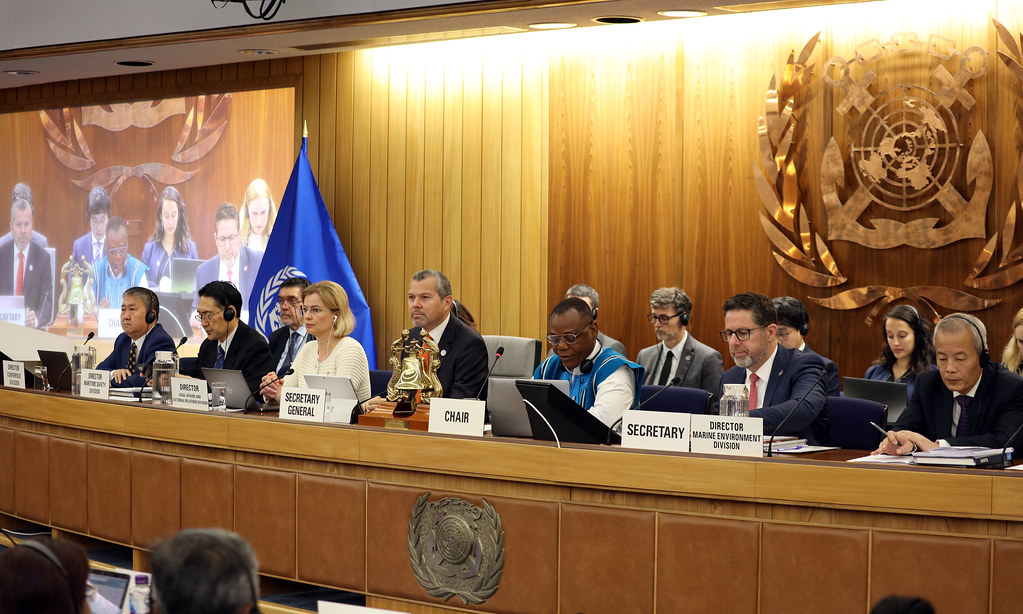
The International Maritime Organization (IMO) aims to establish the world’s first global carbon pricing mechanism for any industry through its Net-Zero Framework (NZF), designed to accelerate the transition to alternative maritime fuels. However, a lack of global consensus at the MEPC Extraordinary Session this past October led member states to adjourn the session and delay the vote by a year.
This postponement has raised some concern over the potential for further regulatory fragmentation and a subsequent increase in cost and complexity in compliance matters. Others believe the delay could prove beneficial, offering an opportunity to resolve outstanding aspects of the framework, particularly its economic elements, and facilitate further dialogue among member states to achieve broader agreement.
Current picture
The NZF is the IMO’s latest initiative aimed at accelerating emissions reductions across global shipping. It builds on earlier measures introduced under its 2018 Initial Strategy on Reduction of GHG Emissions from Ships, which brought in technical and operational requirements. These included the Energy Efficiency Existing Ship Index (EEXI) and the annual operational Carbon Intensity Indicator (CII), frameworks that require ships to calculate and report their energy performance and carbon intensity over time.
Regional net-zero initiatives have also long been a major driver of climate ambition. The EU Emissions Trading System (EU ETS) was the world’s first international emissions trading system in 2005, with the UK ETS implemented after Brexit. In the USA, there are several subnational schemes such as the Regional Greenhouse Gas Initiative (RGGI) in the US Northeast and a similar scheme in California.
In Africa, Djibouti and Gabon have implemented carbon pricing through their Sovereign Carbon Initiative, while Guinea is developing a carbon pricing instrument for its mining sector. In Asia, the China Emissions Trading Scheme recently expanded to include heavy-industry sectors; Vietnam launched the pilot phase of its national ETS in June 2025; and Japan has plans to make participation in its voluntary carbon-trading scheme GX-ETS mandatory by next year.
This list is by no means exhaustive – according to the World Bank’s State and Trends of Carbon Pricing 2025 report, there are now 80 carbon-pricing instruments (including carbon taxes or emission-trading systems) in operation worldwide.
Reducing complexity
This proliferation of carbon-pricing and emissions schemes around the world is creating a complex compliance patchwork, which could be reduced through the successful adoption of the NZF, according to Sveinung Oftedal, Chief Negotiator on Green Shipping in the Norwegian Ministry of Climate and Environment and Chair of the Intersessional Working Group for the IMO. However, that would only be the first step – following adoption, regional and national schemes would need to recognise the NZF as equivalent, measurement and reporting systems would need to be aligned, conflicting carbon prices would need to be avoided, and NZF enforcement mechanisms would need to be accepted.
Speaking to ICS Leadership Insights, Oftedal said: “There were clear indications from the EU side that they were prepared to revise their regulatory regime with the intent of harmonising with the IMO. We don’t want a patchwork of regulations, and one important element of the Net-Zero Framework is that it could avoid this by establishing a global agreement.”
Laurence Odfjell, Chairperson at Odfjell SE, echoed the role the NZF could play in avoiding regulatory complexity. Also speaking to ICS Leadership Insights, Odfjell noted: “We may see initiatives emerge independently in regions such as China, Africa and India. If these regulations differ from one another, we could face conflicting compliance requirements, which would complicate global operations.”
Work underway
Despite the adjournment of the vote to adopt the NZF, many in the industry still believe that progress will continue. Oftedal confirmed that the IMO Intersessional Working Groups (ISWGs) are making progress on the technical elements of the NZF.
“It’s promising that discussions on the technical elements continue. Some have claimed that we don’t have full certainty on the implications of the NZF, including the reward framework and how to precisely calculate greenhouse gas fuel intensity (GFI) but it’s positive that we’re not losing time where we can progress ahead of providing further clarity on these areas,” he said.
The business imperative of net-zero emissions could also prompt maritime companies to continue to make progress in reducing emissions, according to Odfjell: “The most forward-looking companies already understand that climate-related risk is not just an environmental issue. It is a material business risk that influences operational resilience, asset values, and long-term competitiveness.”
The IMO’s 2023 GHG Strategy, which set the target of achieving net zero emissions by or around 2050, is not explicitly affected by the MEPC adjournment. The strategy is subject to mandatory reviews every five years, with the first of these to take place in 2028.
Building bridges
Speaking to ICS Leadership Insights, Edmund Hughes, Director at Green Marine Associates, echoed the call for dialogue with concerned member states in order to make progress. “To get back on track and rebuild confidence, it will be imperative to address concerns raised by member states, especially regarding the economic elements of the NZF, as these were the most contentious matters,” explained Hughes.
For shipowners less closely involved in the detailed negotiations, who might have concerns about how the NZF will work in practice, the one-year adjournment offers an opportunity to gain clarity and ensure their existing investments in fuels such as LNG can support compliance, explained Oftedal.
“The regulatory framework doesn’t specify any type of energy so it has been designed to offer significant flexibility. Investing in LNG, for example, will still prove beneficial. This isn’t regulation seeking to punish the industry but instead works with existing solutions and strategies to understand how these can support a low-carbon future,” said Oftedal.
Shipping in the low-carbon future
If NZF is successfully adopted, it could reinstate confidence in investment in new fuels and technologies, according to Odfjell. “The industry needs well-defined standards for fuel quality, emissions measurement methodologies, and compliance procedures. These details will provide the confidence required for companies and fuel producers to make long-term investments,” he said.
While the shipping industry will need to compete with other sectors for the same supply of renewable energy, the NZF aims to provide a market signal that will encourage further investment in bunkering infrastructure, alongside the scaling of new fuels and technologies that could ultimately serve to boost availability and economic viability.
“The industry has already done so much to demonstrate how shipping can continue to serve the global economy – there’s every reason for us to be confident that it will continue to do this in the low-carbon future. Our hope is that regulation can provide the industry with a predictable framework that allows time and investment to be allocated correctly to the best options when it comes to alternative technologies and fuels,” concluded Oftedal.


