Redrawing the trade map
As businesses diversify supply chains and governments pursue new trade agreements, global commerce is becoming more distributed, impacting shipping routes, cargo flows and emerging trade corridors.
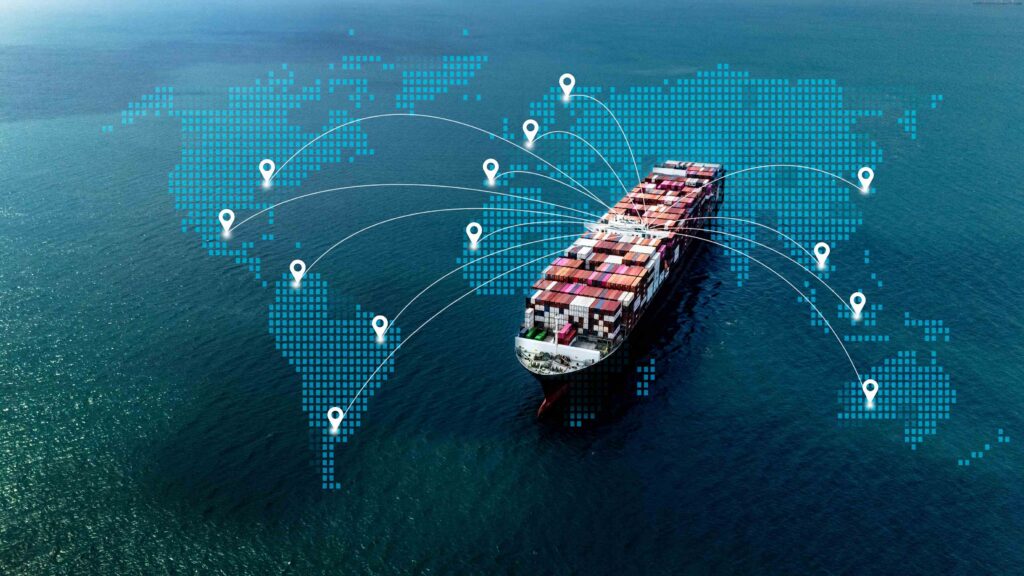
Although a relatively small number of major trading relationships defined global trade for many decades, the current operating environment is experiencing a lot of upheaval fuelled by natural occurrences and geopolitical factors. In fact, the recently published ICS Maritime Barometer 2025–2026, identifies geopolitical instability as the leading concern among maritime leaders for the fourth consecutive year. This has meant that new alliances and ways of working are becoming increasingly commonplace.
Recent developments including the UK–India Free Trade Agreement, progress on EU–India negotiations and growing Gulf–Asia partnerships reflect a broader trend towards diversified trading relationships. At the same time, tariffs, export controls, and economic security concerns are encouraging governments and businesses to reassess how goods are manufactured and transported around the world.
The rise of regional agreements
As governments pursue new trade agreements and companies diversify sourcing strategies, the geography of global trade is beginning to evolve. Marco Forgione, Director General of the Chartered Institute of Export & International Trade, argues that growing economic and geopolitical uncertainty is encouraging countries to pursue more targeted trade relationships.
“The global trading order is facing increasing pressure,” he said. “The weaponisation of supply chains, geopolitical events and recent tariff programmes are fracturing many established trading partnerships.”
At the same time, multilateral institutions are often struggling to build consensus on complex trade issues, encouraging governments to pursue bilateral and regional agreements instead. “The lack of action at multilateral organisations is pushing governments towards seeking smaller, targeted deals with like-minded nations or blocs rather than waiting for consensus based decisions.”
Forgione describes this trend as a shift in the nature of global trade rather than a retreat from it. “Many governments still want to reap the benefits of international trade, but with more emphasis on trading with friendly nations rather than opening up to the entire world.”
This approach is creating opportunities for a wider range of countries and regions, he added. Expanding trade relationships involving Southeast Asia, the Gulf, Latin America and other emerging markets are contributing to a more distributed global trading environment.
Professor John Manners-Bell, Founder of the Foundation for Future Supply Chain and Chief Executive of Transport Intelligence, also believes that the change in trade patterns is a strategic choice rather than a retreat from globalisation. When asked whether companies are genuinely diversifying supply chains or simply adding redundancy, he says, “The answer is both. Companies are employing a whole range of supply chain strategies in order to mitigate many of the risks which have become apparent over the past decade. Natural disasters, Covid-19, geopolitical events and even industrial action have meant that it is important to reduce dependence on single sources of goods or individual markets.”
A changing trade environment
The World Bank’s April edition of Trade Watch found that global goods trade expanded in 2025, with global value chains adapting to policy turbulence through trade diversion and the creation of new trading relationships. While the impact varies across sectors and regions, the result has been a wider reassessment of supply chain risk and market concentration.
Manners-Bell pointed to the growing adoption of “China Plus One” strategies, where companies maintain operations in China while expanding production and sourcing into other markets, particularly across Southeast Asia. At the same time, manufacturers and retailers are increasingly seeking alternative suppliers and production locations to reduce dependence on any single geography.
Alongside diversification, many companies are also holding inventory closer to end consumers to reduce exposure to disruption. The World Bank’s Global Supply Chain Stress Index points out that disruptions affecting container shipping and global supply chains are underlining the growing importance of reliability as production and sourcing become more geographically distributed.
“In the short term it may look like a supply chain is efficient,” said Manners-Bell. “But if it breaks down when faced with disruptive events it is far more costly to fix than if risk mitigation strategies had been deployed.”
Implications for shipping
For the shipping industry, changing trade relationships may prove just as significant as changes in overall trade volumes. Diversified sourcing often results in more complex supply chains involving additional suppliers, intermediate processing locations and alternative transport routes. In some cases, this can increase shipping demand rather than reduce it – particularly in emerging regional corridors and intra-regional markets.
Lars Jensen, CEO of Vespucci Maritime, says, “The wider region covering the Far East, Indian Subcontinent, Middle East and Africa is where most trade growth is concentrated, and it is likely to remain the highest-growth area for decades.” He adds that carriers are already responding by deploying larger vessels on growing routes, citing Asia–West Africa services as an example of how rising regional volumes are changing fleet deployment.
Manners-Bell points to the growth of regional cargo movements as one example. “The growth has been in regional flows of cargo throughout Southeast Asia,” he said. “Secondary ports will prosper along with shipping lines providing regional services.”
He also highlighted the impact of nearshoring and regional manufacturing strategies. “In Europe, the trend towards nearshoring is propelling short sea shipping and benefiting ports in the Mediterranean.”
A more complex landscape
Governments are increasingly linking trade policy to broader economic security objectives, particularly in sectors considered strategically important. Export controls, sanctions regimes, and investment screening mechanisms are becoming more common features of the global trading landscape. Forgione believes this is an area shipping companies should monitor closely. “Industries like steel, critical minerals and technology are being valued for their defence contributions as much as their economic value,” he said. He also warns that compliance requirements are becoming more demanding as governments expand the use of sanctions and export controls.”
For Jensen, adaptability will remain central as carriers navigate increasingly fluid trade and political conditions. “Carriers should remain adaptable and avoid becoming overly exposed to any single geopolitical alignment,” he said. For shipowners, operators, and logistics providers, this means navigating a more complicated regulatory environment while maintaining efficient and reliable services.
While the long-term direction of global trade remains uncertain, trade relationships continue to evolve. For shipping companies, ports, and logistics providers, understanding how these changes influence cargo flows and network planning will remain an important consideration in the years ahead.


