Powering the long haul: batteries at sea
Batteries are already transforming short-sea shipping, but taking electrification across the oceans presents an altogether different challenge. What will it take for batteries to make the leap into deep-sea operations?
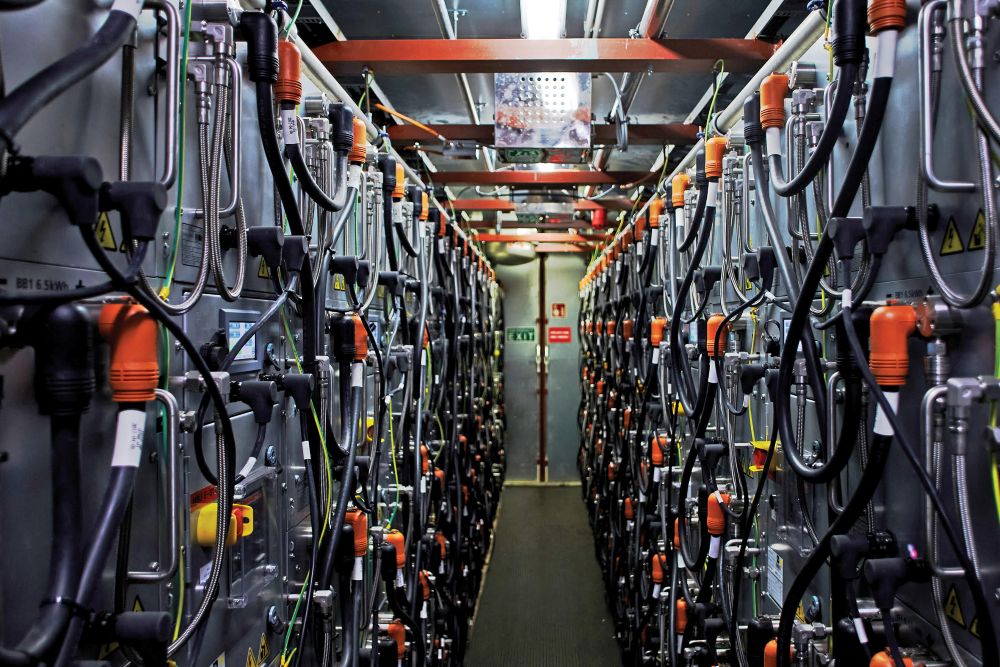
The global maritime industry stands at a critical juncture. Responsible for nearly 3% of global greenhouse gas emissions, shipping faces mounting regulatory pressure from the International Maritime Organization (IMO) and regional bodies like the European Union to decarbonise. In response, electrification has emerged as a star player in short-sea shipping, with battery-electric ferries, tugboats and short-haul cargo vessels already operating worldwide.
For routes with frequent access to shore power, predictable schedules and lower energy demands, battery technology is no longer an experiment. But as shipping targets full decarbonisation, can batteries move beyond short-sea operations and play a meaningful role in deep-
sea shipping?
Energy density versus transoceanic trade
The fundamental challenge is scale. A large vessel crossing an ocean requires vast amounts of continuous energy for days or weeks without refuelling. Current batteries simply cannot match the energy density of conventional fuels without imposing major weight and space penalties.
As Ship Design Manager for Grimaldi Group, Andrea d’Ambra explains, “Battery energy density remains far too low for primary propulsion on large deep-sea vessels. Providing sufficient energy for even one
or two days of navigation would require such a large number of batteries that a significant proportion of the vessel’s cargo capacity would be lost. The challenge becomes even greater for voyages lasting several days or weeks.”
Torsten Büssow, Director, Electrical & Power Systems Business, Wärtsilä Marine, puts the challenge into stark numerical terms. A vessel operating with a 10-megawatt (MW) propulsion load for four weeks would require close to 7,000 megawatt-hours (MWh) of energy, translating, with today’s technology, into tens of thousands of tonnes of batteries.
While improvements in energy density, integration and power electronics can reduce their footprint, Büssow says weight and
space will remain important considerations. Even emerging technologies are unlikely to transform the equation overnight.
Matching batteries to the voyage
The question, therefore, may not be whether batteries can replace fuel entirely, but where they deliver the greatest value.
Büssow draws a clear distinction between vessel profiles. On short routes, typically below three hours and often under 1.5 hours, batteries are already proven as primary propulsion, particularly for ferries able to recharge at either end.
The next frontier is medium-range trades of around eight to 10 hours, including smaller container feeders, bulk carriers, and RoRo vessels. Projects are beginning to enter the market, although funding can still be needed to offset higher upfront capital costs.
Deep-sea shipping is different. For ocean-going voyages, Büssow says batteries currently create most value as part of hybrid systems rather than as standalone propulsion.
That position is shared by d’Ambra: “their most realistic role in deep-sea shipping will remain as part of an integrated energy system. Batteries can work alongside engines powered by fossil, bio-based, or alternative fuels, supporting blackout prevention, peak shaving, load optimisation, and potentially zero-emission operation during specific and limited phases.”
In these configurations, batteries can absorb energy during periods of low demand and release it during peaks, allowing engines to operate more efficiently. They can provide spinning reserve and emergency power while supporting zero-emission operation in ports.
The economics also increasingly matter as low-carbon fuels enter the market at a premium. By reducing fuel consumption, engine running hours and maintenance requirements, hybridisation can help owners improve efficiency today while preparing for tightening emissions requirements.
Building the infrastructure
Even dramatic improvements in batteries themselves would only solve part of the problem.
“Even if battery energy density were to improve dramatically, the industry would still face a major infrastructure challenge. Very large battery installations would have to be recharged during port calls without extending the time required for commercial operations. This would require extremely powerful shore-side charging facilities and adequate electrical-grid capacity at ports,” says d’Ambra.
Progress is already being made. Büssow points to the EU programme to equip major ports with the standardised IEC (International Electrotechnical Commission) 80005 high-voltage shore power, enabling ships both to switch off engines in port and charge larger battery installations. Meanwhile, the Maritime and Port Authority of Singapore (MPA) has also begun developing charging infrastructure
specifically for harbour craft, launching its first public marine charging point at Marine South Pier.
For vessels spending several hours alongside, existing shore-power standards could provide much of the required framework. Faster-turnaround operations such as ferries require more specialised solutions, with the Megawatt Charging System emerging as one potential standard for smaller high-power installations.
The grid itself is another consideration. Ports will increasingly need to combine smart energy management, local energy storage, renewable generation and load balancing to accommodate large charging loads without destabilising regional electricity networks.
Safety at scale
Larger battery installations also place greater emphasis on thermal management, fire protection and onboard procedures.
Büssow says regulation has progressed alongside the technology, with safety requirements increasingly differentiated by battery chemistry. Battery rooms using lithium iron phosphate (LFP) chemistry, for example, can now accommodate installations of up to 25 MWh.
“The development of standards and regulations is progressing alongside advances in battery technology, helping to ensure that larger battery installations can be deployed safely,” he says.
Crew capability will evolve alongside the technology. Increasing automation means the challenge is not simply maintaining battery systems, but ensuring crews understand and trust increasingly integrated control systems so vessels can realise their full efficiency benefits.
A hybrid path forward
Fully battery-powered ships crossing oceans remain a distant prospect. But that does not make batteries peripheral to deep-sea decarbonisation.
Instead, the emerging picture is one of an integrated energy system in which batteries complement low-carbon fuels, shore power, wind-assisted propulsion and efficiency technologies.
As Büssow explains, “Looking ahead, decarbonisation will not rely on a single technology. The most practical pathway is an integrated energy mix combining batteries, low-carbon fuels, shore power, further propulsion efficiency measures, and advanced energy management, with each technology contributing where it creates the greatest value.”
For deep-sea shipping, therefore, the battery revolution may look very different from the one already underway in ferries and short-sea vessels. The immediate opportunity is not to replace every engine with a battery bank, but to use batteries where they can make the entire ship cleaner, smarter and more efficient.


