Succeeding as a gateway to the globe
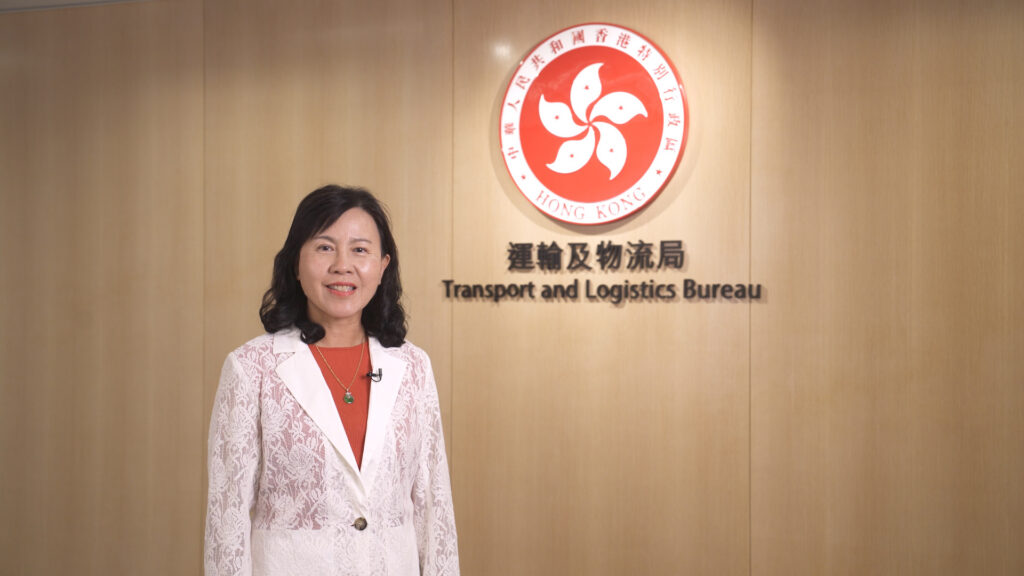
Mable Chan, Secretary for Transport and Logistics, Government of the Hong Kong Special Administrative Region, speaks to ICS Leadership Insights about Hong Kong’s unique internationalised position, the importance of promoting seafarer welfare and the role of courage, change and collaboration in future success.
Q. What is your long-term vision for Hong Kong’s role in global shipping and logistics, particularly as supply chains evolve post-pandemic?
A. We have a vibrant maritime industry and are highly internationalised, with the ability to connect with the Chinese Mainland and the rest of the world. As a result, we’re in an excellent position to seize opportunities and overcome challenges. Hong Kong continues to rank highly on the International Shipping Centre Development Index – in 2025 we were ranked fourth for the sixth consecutive year – so we’ve used our unique position to really deliver when it comes to the quality of our service.
On the logistics front, our aim is to develop Hong Kong into a sustainable international smart logistics hub focusing on high-value goods and e-commerce. According to the IMD World Competitiveness Yearbook, Hong Kong ranked in the global top five in terms of distribution infrastructure in 2025. We will continue to spearhead the modern logistics development of Hong Kong and demonstrate our status as a global maritime capital.
Q. What lessons has Hong Kong’s maritime and logistics sector drawn from recent global disruptions?
A. Our approach is built on dialogue across our industry in order to make our ecosystem more vibrant and better prepared for challenges. In terms of enhancing our competitiveness, this includes our plans to develop Hong Kong into a green port by elevating our green maritime fuel bunkering and trading capabilities, which is very much aligned with the International Maritime Organization’s (IMO) policy and will help
us increase our competitiveness while supporting a wide range of businesses of various sizes.
In terms of resilience, we’ve ensured Hong Kong remains an international logistics hub – even in times of global disruption – through an international “Partner Port” Network around the globe and a comprehensive “rail-sea-land-river” intermodal transport system connecting to the inland region of the Chinese Mainland.
Q. The global maritime industry is accelerating efforts to decarbonise. What steps is Hong Kong taking to support shipping’s net-zero journey, and how are you working with international partners on this agenda?
A. Our goal is very much to lead and support efforts when it comes to realising the IMO’s target of reaching net-zero emissions by 2050. This has included our Action Plan on Green Maritime Fuel Bunkering, introduced at the end of last year, which we have since supported with a raft of measures to position ourselves as an international green maritime fuel bunkering centre. These included adopting a multi-fuel strategy catalysing the green maritime fuel supply chain and trades, building a green port, and launching the Green Maritime Fuel Bunkering Incentive Scheme.
Q. How do you see digitalisation, AI, and emerging technologies reshaping shipping and logistics in the region, and what role can Hong Kong play as a hub for maritime innovation?
A. Data and digital transformation will prove important across shipping, aviation, and logistics. The use of digital systems, combined with data sharing, will definitely increase the efficiency of our port handling, which is already only half of the average time globally, with ocean-going vessels typically spending just one day in our port to complete handling.
The real benefits of these technologies will include the ability to track cargo with total accuracy, as well as monitoring temperatures of perishable goods. This data can also be used when it comes to raising finance and securing insurance coverage.
Ultimately, the growing use of these technologies will help enhance efficiency and effectiveness in a way that ensures we provide increased convenience to traders, liners, and logistics companies alike.
Q. The industry faces a global challenge in attracting and retaining skilled people. How is Hong Kong supporting seafarer welfare and encouraging the next generation to pursue careers in shipping and logistics?
A. Engaging the talent of the future has a pivotal role to play for the maritime and logistics industry.
We are committed to talent development through our Maritime and Aviation Training Fund (MATF), launched in 2014 with a total commitment of USD 65 million by 2023/24. MATF provides financial support for upskilling, career advancement, and long-term talent sustainability in the maritime, aviation and logistics industries. It also plays a key role in attracting and retaining young talent through event sponsorship and by fostering collaboration between the government and industry stakeholders.
We’re also very focused on seafarer welfare – and this has been a key consideration since we established our port welfare committee in 1947. We provide seafarers with facilities to make them feel less far from home, including everything from guest rooms to places of worship, which we hope can play a part in underlining the attractiveness of a career in maritime.
Q. As a leading international maritime centre, how is Hong Kong balancing its regional priorities with its responsibilities as a global hub within international trade and shipping?
A. The combination of regional and global is at the heart of Hong Kong’s very unique position and our values – we don’t see any conflict between our regional priorities and our role as a global hub. Instead, our deep regional integration actually helps to strengthen our global standing.
Whether it’s the green transformation, digitalisation, or disruptions to the global supply chain, Hong Kong has the ability to deliver both within our region and globally through our free economy, with minimal barriers, zero tariffs, and a commitment to openness and innovation that can drive a vibrant global shipping industry.
Q. As a senior government leader in a dynamic sector, what advice would you share with the next generation of maritime leaders?
A. I believe there are three key attributes that are important to succeeding as a senior member of government: courage, change, and collaboration.
With the world changing so quickly, it’s important to embrace change and to remain self-aware and courageous. One of the best ways to do this is to build deep partnerships and collaborate effectively, which will help set the next generation up for success.


