ICS Maritime Barometer Report 2023-2024
The 2023-2024 ICS Barometer is the latest full scale annual survey of risk and confidence among maritime leaders.
C-suite global decision-makers from across the industry, nearly 30% of whom are shipowners and 26% are ship managers, have provided insight into key factors influencing their decision-making and the confidence they have in mitigating the impact of ongoing challenges to their business operations.
The survey and its responses capture year-on-year data on the following:
• C-suite perception of the key challenges and
opportunities impacting the maritime sector today.
• The evolving risk profiles of the industry.
• Changes in confidence when it comes to a business’ capacity to respond to or mitigate impact.
This year’s survey took a deep dive into the rising trend of protectionism impacting the supply chain, assessing how the industry perceives new trends of reshoring, offshoring, nearshoring and friendshoring — driven not only by geopolitical forces but also market incentives, availability of infrastructure and skilled labour.
The report is divided into four main sections:
• Section 1: Risks factor for shipping from political instability to industry reputation, how the C-suite views the threats and their capabilities around key issues.
• Section 2: Decarbonisation, fuels and emissions a deep dive on attitudes to the many concerns on climate that are dominating industry discussion, from fuel choice to funding.
• Section 3: Special Focus on Reshoring, offshoring, nearshoring and friendshoring and their impacts on maritime.
• Section 4: National Focus on the United Kingdom, which showcased the highest number of respondents this year.
Section 1: Risk factors for shipping

The top three perceptions of risk by maritime leaders against shipping’s capacity to mitigate risks are political instability, cyber-attacks and malicious physical attacks.
This involves a low risk of confidence when addressing the issue considering the pandemic’s challenges.
Political instability is a major point taken this year; it is a risk multiplier that is threating policies, trade agreements, and relationships. This includes the consequence of the ongoing conflict in Ukraine.
Section 2: Decarbonisations, fuels and emissions
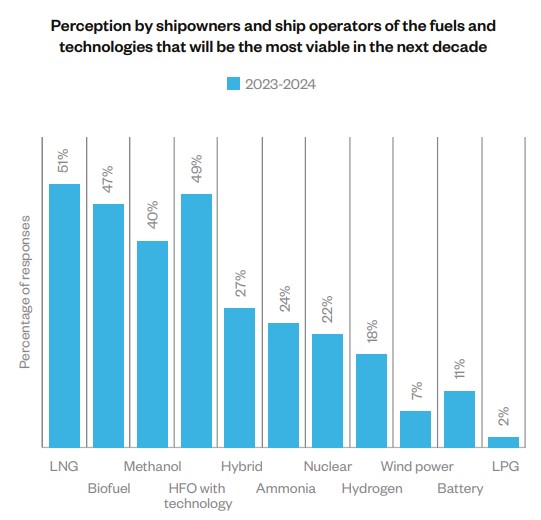
Fuel continues to play a crucial role in the decarbonisation efforts of the shipping industry. While the sector anticipates a future reliant on multiple fuel sources, the perception of individual technologies has shifted significantly over the past two years.
Responses demonstrate sustained confidence in LNG, biofuels, and heavy fuel oil (HFO) with abatement technologies for the next decade. Highlighting the enduring preference for familiar energy sources during a period of uncertainty for the shipping industry. However, the perceived viability of these fuels has diminished compared to the outlook in 2022-2023
Section 3: Nearshoring, Reshoring, Offshoring and Friendshoring

When shifting to de-globalised operations, respondents shared how they saw a significant increase in competition for local fuels and energy supplies.
This is through the fuel cost-of-living crisis caused by geopolitical turmoil and sanctions.
Maritime does not contribute to Nationally Determined Contributions (NDCs) for local governments; therefore, they may not be prioritised in low and zero emission fuels and energy.
This follows, the impact point for respondents for financial vulnerability and costs which is likely to impact the resilience of maritime businesses for those who shift to primarily de-globalised operations.
C-suite respondents considered in a de-globalised environment; declining tonne-mile demand would be the third most significant variable affecting shipping operations. Fuel supply is still significantly impacted by sanctions against Russia, with the ongoing crises in the Red and Black Seas.
Section 4: National Focus (United Kingdom)
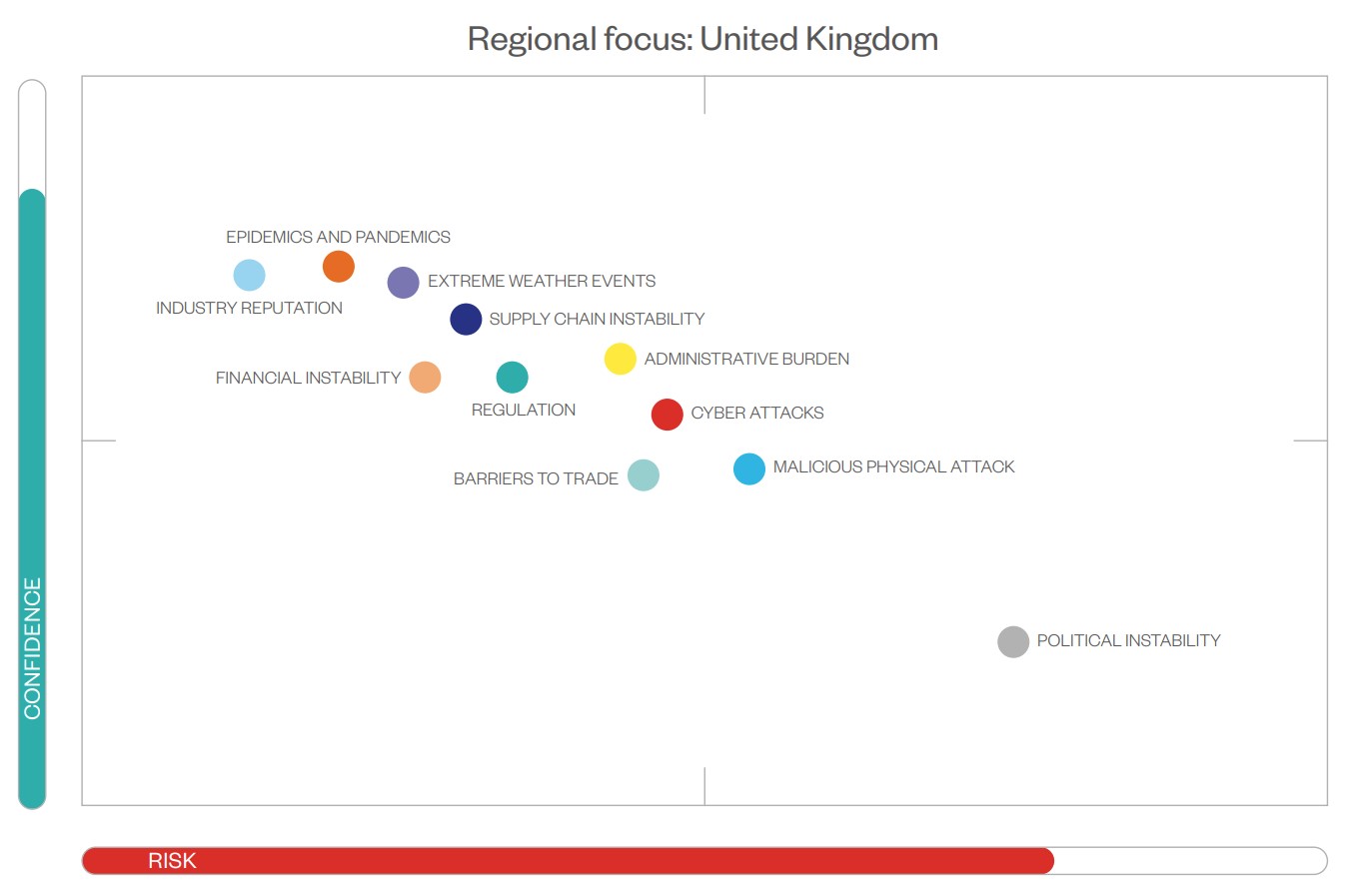
The United Kingdom had the highest participation from a single country in this years Barometer Survey.
Political instability was identified as the highest risk factor by respondents in the UK. Indicating the continuing uncertainty arising from wars, conflicts, regional tensions, and elections in the UK.
Related content

ICS Maritime Barometer Report 2025-2026

ICS Maritime Barometer Report 2024-2025

ICS Maritime Barometer Report 2022-2023
