Navigating a new era: collaboration, regulation, and realism
Held in the historic Athens Conservatoire, the ‘Shaping the Future of Shipping’ Summit last month brought together maritime leaders from around the world for a day of high-level dialogue on the sector’s strategic priorities.

Hosted by the International Chamber of Shipping (ICS) in partnership with the Ministry of Maritime Affairs and Insular Policy of the Hellenic Republic and the Union of Greek Shipowners, the Summit marked a timely day of reflection for the industry as it confronts the intersecting pressures of decarbonisation, geopolitical tension, and global trade fragmentation.
Over the course of the day, one clear message emerged: the future of shipping must be built on global collaboration, not protectionism.
A call to unity in fragmented times
Opening the Summit, on 11 June 2025, ICS Chairman Emanuele Grimaldi spoke candidly about the shifting context in which global shipping now operates. “In a period of phenomenal upheaval, the world around us is shifting in profound and sometimes disconnecting ways,” he said, warning that rising trade barriers are adding complexity, increasing costs for consumers, and eroding the co-operative spirit on which maritime trade depends.
“We must continue to think and act on a global scale,” he urged. “Shipping, by its very nature, is a global industry. It makes little sense to tackle our challenges in fragmented regional ways.”
Eyes on the IMO and the path to net zero
Much of the Summit’s focus was on the forthcoming ratification of the International Maritime Organization (IMO) Net-Zero Framework. There was strong support among attendees for multilateral action through the IMO, with speakers urging governments and industry alike to push for adoption in October.
Chris Bonett, Malta’s Minister for Transport, Infrastructure and Public Works, underlined the urgency: “We have to get the job done in October. If we want to keep a predictable industry, then we have to, all of us, implement the IMO Framework because that will apply for everyone. I cannot stress that enough.”
Nick Brown, CEO of Lloyd’s Register, noted the significance of recent developments at the IMO’s Marine Environment Protection Committee (MEPC), highlighting a “more aggressive reduction curve than many were expecting”. He urged shipowners to use this momentum to drive action at the vessel level: “Every single drydocking of every single vessel must now be fully evaluated to capture efficiency, efficiency, efficiency – as quickly as possible.”
Yet questions were raised about how representative the process has been.
Melina Travlos, President of the Union of Greek Shipowners, cautioned that “the expert input of the industry must be fully reflected in maritime policymaking, at national, regional and global levels”. She expressed concern that recent IMO deliberations did not sufficiently incorporate industry voices, noting that the IMO “regulates only ships—it cannot directly regulate the other stakeholders.”
She added: “Without safe, scalable and globally available alternative fuels, decarbonisation will remain a theoretical goal. Funds raised must be directed back into the industry to support its transition. No growth is possible on the back of stranded investments.”
Decarbonisation needs all hands
While the IMO remains the cornerstone for regulatory progress, speakers were united in the view that the shipping industry cannot go it alone. Ioanna Procopiou, BIMCO Vice Chair and CEO of Prominence Maritime SA, delivered a blunt assessment: “There are good regulations and bad regulations. Bad regulations can destroy any industry.” She emphasised that shipowners alone cannot bear the cost or responsibility of decarbonisation: “We need the co-operation of all stakeholders— charterers, engine manufacturers, cargo owners, bunker suppliers, energy providers. At the moment, we are going to be paying and polluting because there’s no way of complying.”
The need for whole-system transformation was echoed by others, including Rolf Thore Roppestad, CEO of Gard, who stressed the risks of creating misaligned incentives through isolated national or regional rules. Melina Travlos warned that “unrealistic set goals,” increased regionalism, and fierce international competition are threatening both the sustainability and integrity of maritime regulation.
Fu Xuyin, Vice Minister of Transport for the People’s Republic of China, provided a perspective on how this transformation is playing out in the world’s largest shipping market. “Intelligent and smart shipping are flourishing,” he said via translator, highlighting China’s efforts to green its ports and fleet. Shanghai Port has completed the country’s first green methanol bunkering operation, and 60% of container trucks at key hub ports now run on clean energy. “We have put into operation the first pure battery-powered river-to-sea containership capable of carrying 700 TEU,” he noted.
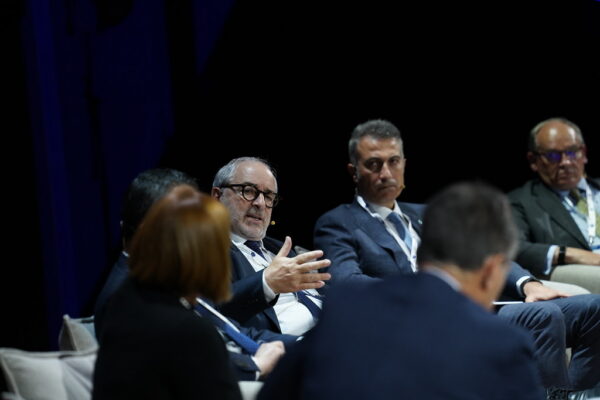
Yet, Mr Xuyin also struck a warning note, urging greater co-operation amid rising unilateralism and protectionism. “The selective implementation of discriminatory measures, including port fees and tariffs, seriously disrupts the world economic order and poses severe challenges to the development of the shipping industry.” He emphasised that “multilateralism is key to the stability of the global supply chain.”
Human capital, maritime security and institutional voice
Beyond fuels and frameworks, the conversation also returned repeatedly to people and safety. Prime Minister of the Hellenic Republic Kyriakos Mitsotakis described ships as “advanced floating factories” requiring engineers adept in both ammonia fuel cells and AI-enabled navigation systems. This focus on the human dimension was reinforced by Marina Hadjimanolis, Shipping Deputy Minister to the President of Cyprus, who stressed the need to invest in maritime skills and wellbeing.
Melina Travlos, who recently addressed the UN Security Council on maritime security, warned that the industry faces growing threats “which put life at sea under direct threat.” She called for effective policymaking that does not undermine the sector’s sustainability: “Shipping needs a global regulatory framework that reflects its nature. A framework that is built on realism, that enables free competition and fosters innovation.”
Nick Brown praised her efforts, saying: “We cannot take safety and security for granted. We’re striving to make our industry cleaner in what is an ever more uncertain and volatile world.”
Turning dialogue into action
While the summit offered no illusions about the scale of the challenge ahead, there was a palpable sense of determination among speakers to move beyond rhetoric. The decisions taken at MEPC in April were widely recognised as a turning point but also as the beginning of the next, harder phase – delivery. The key actions emerging from the Summit were to support the IMO Framework, push for adoption in October, and prepare for consistent global implementation.
On the importance of the debate, Apostolos Tzitzikostas, European Commissioner for Sustainable Transport and Tourism, added: “The European Union will always be a multilateral player, working hand in hand with international partners.” He said it was time for the industry to “translate vision into action” and said no one could tackle the challenges alone. He called for coordinated action and strategic investment and “above all, strong collaboration”. Of the EU’s future prosperity, he said the maritime sector was not just a stakeholder but a strategic partner.
Vasilis Kikilias, Greece’s Minister for Maritime Affairs and Insular Policy, also reflected on the significance of the event. “Let’s hear from the best of the best. We’ll talk about problems, yes, but also the solutions. There are no problems without solutions and you have proved that, dear friends, time and time again.”
As ICS Chairman Grimaldi concluded: “The decisions taken represent progress, and now we must turn that progress into practical action.”
Melina Travlos put it simply: “No challenge is beyond our reach if we face it together.”