ICS Maritime Barometer Report 2025-2026
The 2025-2026 ICS Maritime Barometer Report is the latest full scale annual survey of risk, confidence, and impacts among maritime leaders.
C-suite decision-makers from across the industry, nearly 53% of whom are shipowners and 39% ship managers, have provided insight into the key factors influencing their decision-making and the confidence they have in mitigating the impact of ongoing challenges to their business operations.
The report is divided into five main sections
- Section 1: Risk factors for shipping from political
instability to industry reputation, how the C-suite
views the threats and their capabilities around
key issues. - Section 2: Decarbonisation, fuels and emissions: a
deep dive into attitudes towards climate concerns
that are dominating industry discussion, from fuel
choice to funding. - Section 3: Fuels and technologies, including the
perception of the viability of alternative fuels and
how this has evolved over the last four years. - Section 4: Shipowners Focus, looking sentiment
amongst shipowners against the risk and impact
factors against the wider findings of this report. - Section 5: Special Focus, maritime leaders were
asked if they are changing their plans as a result
of the delay in October 2025 to the International
Maritime Organization’s Net-Zero Framework vote.
The full report can be downloaded here.
The executive summary of the report can be downloaded here.
SECTION 1: Leading maritime risks and industry confidence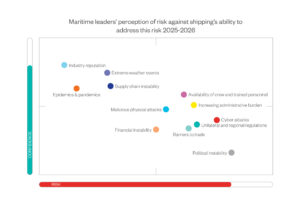
The 2025–2026 ICS Barometer risk survey shows an industry operating under intensifying systemic pressure, with political instability emerging as the primary risk driver multiplying other factors including regulatory fragmentation, increasing compliance demands, influencing trade flows, and heightening cyber exposure. Cyber attacks and unilateral or regional regulations follow on as the next highest risks, while barriers to trade carries less risk but is also viewed with lower confidence. By comparison, shipowners place greater emphasis on increasing
administrative burden, edging out unilateral or regional regulations as leading risks.
There is a clear divide between which risks are seen as manageable and those that are largely beyond industry control – with the latter now dominating focus. In contrast, more ‘established’ risks such as supply chain disruption, extreme weather, and pandemics, while still inherently unpredictable, are better understood and more effectively mitigated through planning and preparedness, resulting in higher confidence levels.
SECTION 2: Impact factors for shipping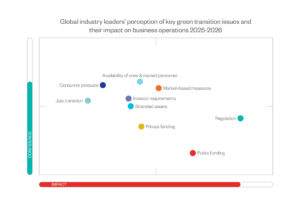
The Barometer results indicate that global maritime leaders perceive the impact of green transition factors on business operations through the lens of an increasingly volatile and fast-moving external environment. As with the risk outlook, these findings should be understood as a snapshot of sentiment captured at a specific moment, shaped by ongoing geopolitical, economic and policy disruption.
Regulation is seen as having the greatest impact on business operations, reinforcing its role in directly shaping compliance requirements, investment decisions and fleet strategy. At the same time, declining confidence suggests that leaders are contending with a policy environment that is becoming harder to anticipate.
A similar dynamic is visible in financing. Public funding is ranked as highly impactful, yet confidence in this is the lowest across all factors. This gap points to a reliance on government support mechanisms that are critical in principle but uncertain in practice, particularly in a context where public spending priorities are subject to rapid change.
In contrast, market-based measures such as carbon pricing are viewed, by some, as both impactful and relatively more reliable, suggesting that tools already embedded in commercial and regulatory systems are easier to incorporate into operational planning.
SECTION 3: Fuels and Technologies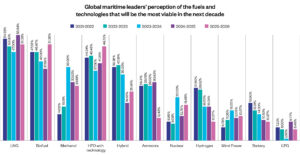
In 2025-2026, maritime leaders are displaying a preference for traditional fuels that have established supply mechanisms.
LNG and biofuels are seen as the most viable fuels over the next decade by Barometer respondents. There is also support for HFO with
technology. Decision-making is increasingly shaped by exposure management within an unpredictable operating environment.
SECTION 4: Shipowner focus
While the overall risk landscape is broadly aligned across the industry, shipowners display a more operationally immediate interpretation of risk, with clearer emphasis on how external instability translates into day-to-day constraints.
Political instability ranks as the leading risk for shipowners, matching the overall survey sample. However, for shipowners, political instability’s significance tends to be shaped by direct exposure through commercial scheduling, fleet deployment decisions and contractual certainty, where disruption is absorbed at the asset level rather than at a strategic distance.
SECTION 5: Special focus
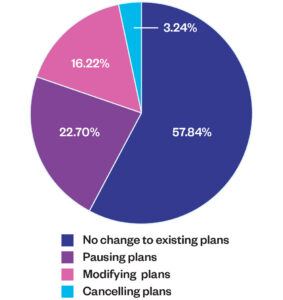
This year’s Special Focus question explored how maritime leaders and their organisations are responding to the delay in the vote to adopt the IMO’s NZF, which is still under negotiation following MEPC 84. As with the wider findings of this year’s Barometer, the results point to a pattern of apparent strategic continuity, but could indicate a more complex underlying dynamic shaped by regulatory uncertainty and timing.
The majority of respondents (57.84%) report no change to existing plans following the delay, while others indicate pausing (22.70%), modifying (16.22%), or cancelling (3.24%) plans. At face value, this distribution suggests a sector maintaining its long-term direction of travel to decarbonisation, while adjusting the pace and structure of investment decisions in response to evolving regulatory signals.
This possible headline stability likely masks a more nuanced reality. A portion of ‘no change’ responses may reflect organisations that had not yet formalised decarbonisation plans and were awaiting the outcome of the NZF vote before committing. In this context, ‘no change’ may indicate continued strategic holding positions rather than active execution.
The full report can be downloaded here.
Related content

ICS Maritime Barometer Report 2024-2025

ICS Maritime Barometer Report 2023-2024

ICS Maritime Barometer Report 2022-2023
